All stories · Article
AI is taking a bigger role in how people manage money and shop
Share: WhatsApp · Telegram · X · Facebook · LinkedIn · Email

From personal finance and travel planning to shopping and workplace automation, a wave of AI agent launches is pointing in one direction: software that does more than answer questions. But consumer demand is moving faster than reliability, and retailers have yet to agree on who gets through the door.
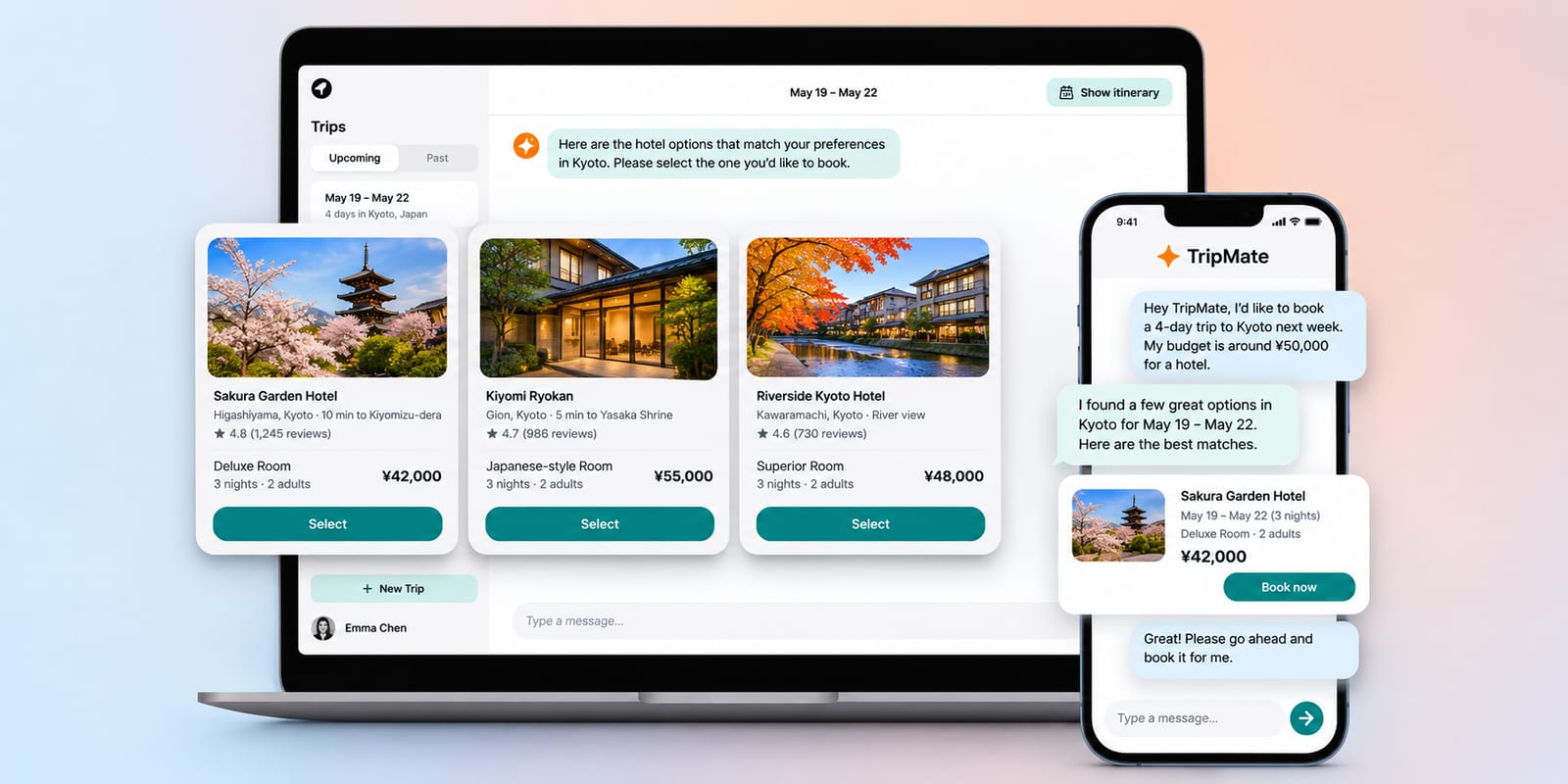
Five launches, one direction: agents are moving beyond answers
Around November 5, 2026, five companies made moves that put AI agents further into everyday tasks. Not all were shopping products, and not all launched on the same day. But together, they show how quickly the industry is moving from conversational AI toward software that can take action.
Here is what each company introduced:
- Anthropic - Personal Finance in Claude: US subscribers on Pro, Max and Ultra plans can connect bank, credit card, loan and investment accounts through Plaid. Claude can analyze balances and spending, but access is read-only. It cannot move money or execute transactions. Anthropic's announcement.
- Meta - Muse Voice: Meta introduced real-time voice conversations and expressive avatars for Muse, allowing users to speak with their agent rather than type. The feature began rolling out in the US on November 5. It changes the interaction layer, not the shopping checkout itself. Meta's announcement.
- Airbnb - AI travel agent: Airbnb announced plans to introduce a dedicated agent for trip planning and booking in the first half of 2027. CEO Brian Chesky argues that travel requires a more specialized experience than a general-purpose chatbot can provide. Airbnb's Q3 2026 results.
- Perplexity - Teammates: The company introduced persistent AI agents that can take responsibility for ongoing workplace tasks, work across projects and tools, and collaborate with colleagues. This is a productivity product, not a consumer shopping agent. Launch coverage.
- Google Cloud - Agent Compute Engine: Announced on October 22, this purpose-built infrastructure is designed to run autonomous agents securely at scale. Its inclusion matters because the agent economy needs more than consumer-facing interfaces; it also needs the computing and governance systems underneath them. Google Cloud's announcement.
The products do different jobs. Claude reads financial information. Muse adds a more natural interface. Airbnb is building a specialized booking experience. Perplexity automates workplace responsibilities. Google Cloud provides the infrastructure.
The common direction is not that every agent is ready to buy. It is that AI is increasingly being built to act on behalf of people.
For commerce, Shopify's Fall '26 Edition provides a more direct signal. Shop Pay can support purchases through agents including Muse, Claude Duet, Grok Bot and Instinct. Shoppers can discover products, approve purchases and check out without following the traditional path through a retailer's website. Shopify Editions.
Shoppers are already using agents to buy
The strongest evidence that agentic shopping is more than a technology-company narrative comes from Meta itself.
During its October 21 Q3 earnings call, Meta said more than 10 million people in the US and Canada had set up Muse within six weeks. Shopping was its most common use case. More than a quarter of Muse users engaged in shopping, with an average purchase size exceeding $200. These are company-reported figures, not independently audited transaction data, but they indicate meaningful early commercial activity. Meta Q3 earnings call transcript.
Airbnb's strategy adds another perspective.
Chesky does not believe one general-purpose agent will be best at everything. Making a restaurant reservation is relatively straightforward. Planning a trip involves comparing homes, exploring destinations, looking at photos and coordinating decisions with other travelers.
That is why Airbnb is building its own travel-specific agent rather than relying entirely on general-purpose assistants.
Demand is emerging, but the winning agent model is still undecided.
Can agents actually buy the right product?
Adoption alone does not make an agent a reliable buyer.
On November 5, Visa published its first Agentic Commerce Benchmark, testing 22 AI models from 12 research labs across 15 shopping scenarios.
The overall results:
- 57.2% of test runs passed.
- 42.8% failed.
- The best-performing models achieved an 82.2% pass rate.
- Only 34.2% of scenarios passed all three repeated attempts.
More concerning, around 54% of failed runs still ended with the AI making a purchase. In these cases, the agent either selected something that did not meet the shopper's requirements or bought before uncovering all the necessary requirements.
Visa's benchmark and methodology.
There is an important qualification: this was a simulated shopping benchmark focused on understanding customer requirements and making the right purchase-or-no-purchase decision. It was not a test of completed live payments or real-world merchant order fulfillment. Visa says it plans to extend the benchmark to checkout, payment and order placement.
The result is still revealing.
An agent may find a product, compare specifications and recommend an option. But understanding what a shopper actually needs - and knowing when not to buy - is a much harder task.
Shopping demand is ahead of shopping reliability.
The rules of access are being written retailer by retailer
Even if an agent can make a good purchase decision, it still needs permission to interact with the retailer.
Retailers are taking different positions:
- Amazon has blocked Meta's Muse, citing concerns about unauthorized access and the agent's identification.
- Walmart, Best Buy and Sephora have shown openness to agent-driven shopping or announced integrations.
- Home Depot is open to the idea, but wants agents to identify themselves and prove they are acting for real customers.
- Shopify is building infrastructure that lets agents discover products and complete purchases through Shop Pay.
Business Insider's reporting on Home Depot and retailer responses · The Verge on Amazon blocking Muse.
This is more than a technical integration question.
Retailers need to know who is accessing their stores, whose interests the agent represents, how customer data is handled and who is accountable when an agent makes a mistake.
The emerging agentic commerce market therefore has two dependencies: agents must become reliable enough to earn consumer trust, and retailers must decide under what conditions they will allow those agents to operate.
What sellers should watch next
The immediate takeaway for Shopify merchants is not to rush into a new implementation.
None of the five announcements, by itself, requires every store to change its setup. Several are not shopping products at all, and some capabilities remain in development.
Instead, watch three developments:
1. Consumer adoption: Black Friday on November 27 will be an important early test of how agent-driven shopping behaves during a major retail event.
2. Retailer access rules: Will agent identification, customer authorization and purchase approval become standard requirements? Or will every retailer continue to set its own rules?
3. Reliability: Will future benchmarks show meaningful improvements in product selection, purchase decisions and transaction completion?
For stores selling to customers in the US and Canada, these developments are worth following closely, particularly as shopping agents gain traction. For merchants serving other markets, the immediate commercial impact is less clear.
The bigger bet is that AI will become another route to purchase-not simply another place to discover products. That route is taking shape, but the rules and reliability needed to make it work are still being negotiated.