All stories · Hot News
Anthropic launches Claude Fable 5.2 and Mythos 5.2, cutting prices by 20%
The new models bring stronger reasoning, coding and agentic capabilities, generate outputs up to 30% faster, and cost 20% less than their predecessors. But Anthropic still recommends Opus 5.5 for most everyday work.
Share: WhatsApp · Telegram · X · Facebook · LinkedIn · Email

Anthropic launched Claude Fable 5.2 and Claude Mythos 5.2 on November 9, introducing an upgraded model designed for demanding technical work, long-running AI agents and complex research.
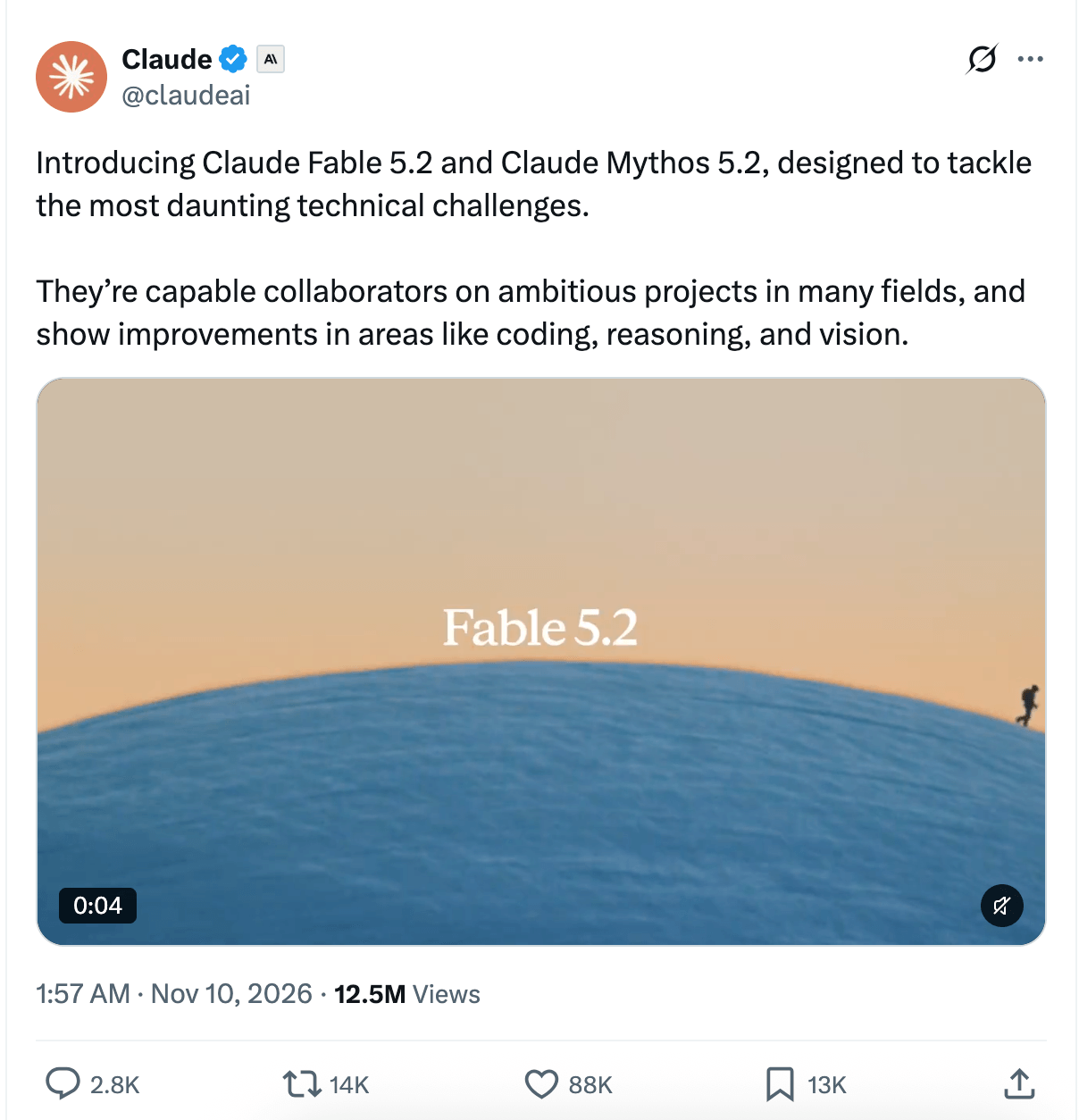
The launch comes with two headline improvements: a 20% reduction in standard API pricing and output speeds up to 30% faster than the previous generation.
Fable 5.2 is available to users across Anthropic's platforms. Mythos 5.2 shares the same underlying model but is restricted to organizations approved through Anthropic's cybersecurity and life sciences verification programs.
Source: Anthropic - Introducing Claude Fable 5.2 and Mythos 5.2
What's new in Claude Fable 5.2?
Anthropic says the upgrade improves coding, reasoning, vision and the ability to handle complex, open-ended tasks.
The technical specifications include:
| Specification | Fable 5.2 |
|---|---|
| Context window | 1 million tokens |
| Maximum output | 128K tokens |
| Input price | $8 / million tokens |
| Output price | $40 / million tokens |
| Output speed | Up to 30% faster than Fable 5.1 |
| Thinking | Adaptive thinking |
| Fast mode | Up to 2.5x faster token generation |
The model is designed for demanding reasoning and long-horizon agentic work, including AI sessions that run for hours, multistep research and projects that require producing a finished document, spreadsheet or presentation.
Anthropic also highlights improvements in several technical areas.
Coding and software engineering
During prerelease testing, Anthropic says Fable 5.2 helped engineers complete software migrations that had previously been considered infeasible.
Mathematical research
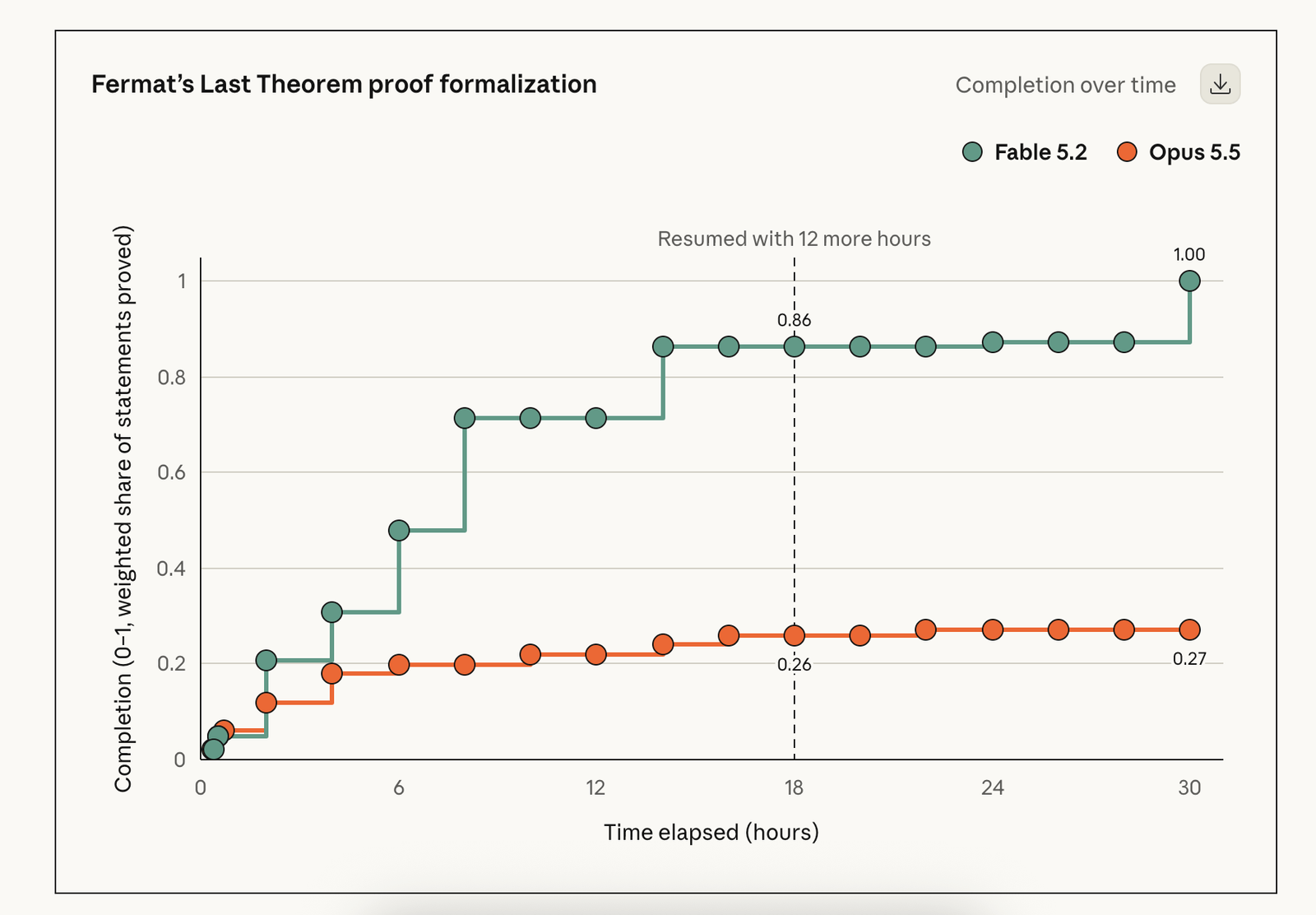
A team of 1,000 Fable 5.2 agents formalized a proof of Fermat's Last Theorem in 30 hours, according to Anthropic. The work used minimal human intervention and no mathematical references, relying instead on intermediate theorem statements to measure progress.
Hardware and robotics
Anthropic reports that Fable 5.2 designed three working electronic devices from scratch, including circuit boards, 3D-printed enclosures and software.
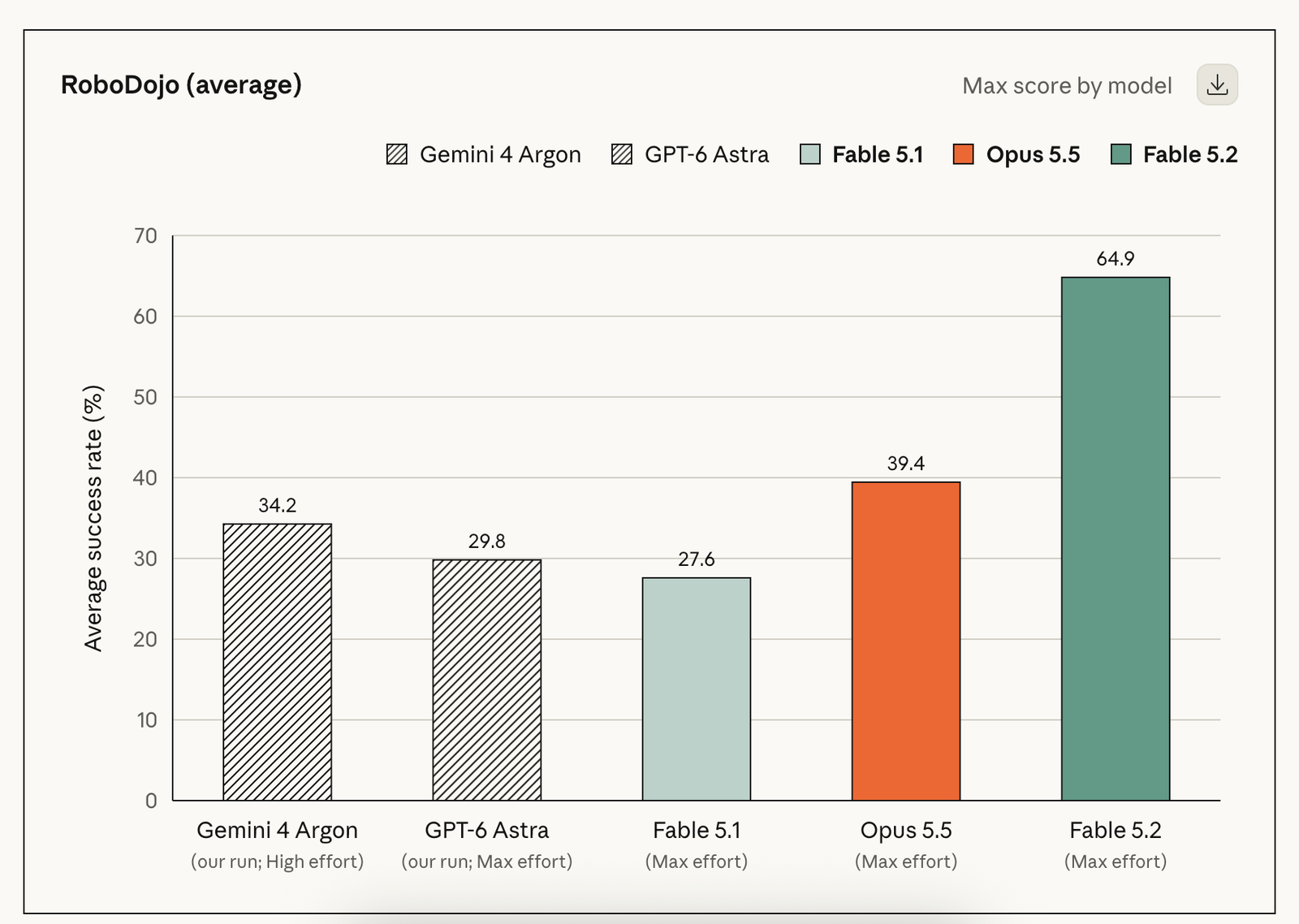
On the RoboDojo simulated robotics benchmark, Fable 5.2 scored 64.9% at Max effort, more than twice the score Anthropic reported for GPT-6 Astra and Fable 5.1 in its internal comparison.
These examples point to a broader ambition: moving AI beyond answering questions or generating code snippets toward coordinating complex work across multiple stages.
Source: Anthropic - model capabilities and performance
The new models come with a 20% price reduction
The pricing change is one of the most immediate developments for developers and businesses using Claude through the API.
| Model | Input / MTok | Output / MTok |
|---|---|---|
| Fable 5.1 | $10 | $50 |
| Fable 5.2 | $8 | $40 |
| Opus 5.5 | $4 | $20 |
| Fable 5.2 Fast | $16 | $80 |
MTok = one million tokens. Prices are in USD.
Fable 5.2 reduces both input and output prices by 20% compared with Fable 5.1.
Anthropic has also introduced Fast mode, which can increase output generation speed by up to 2.5 times. The trade-off is a doubled token price.
Developers can also reduce costs through other mechanisms:
- Batch API: A 50% discount on eligible input and output tokens for asynchronous workloads.
- Prompt caching: Lower costs when previously processed prompt content can be reused.
- Model selection: Using smaller models for routine tasks instead of routing everything through a high-end model.
Source: Anthropic - API pricing
Source: Claude Platform release notes, November 9, 2026
Why Anthropic still recommends Opus 5.5
Despite the lower price, Anthropic is not positioning Fable 5.2 as the default model for every task.
The company recommends starting with Opus 5.5 for most coding and knowledge work, then moving up or down depending on the complexity of the task.
There is a straightforward reason.
Fable 5.2 costs $8 per million input tokens and $40 per million output tokens. Opus 5.5 costs $4 and $20 respectively.
In other words, Fable's standard token prices remain twice as high as Opus.
However, token prices do not tell the whole story.
A more capable model may complete a difficult task with fewer retries, less human intervention or fewer total tokens. That can make its total cost per completed task lower, even when its individual tokens are more expensive.
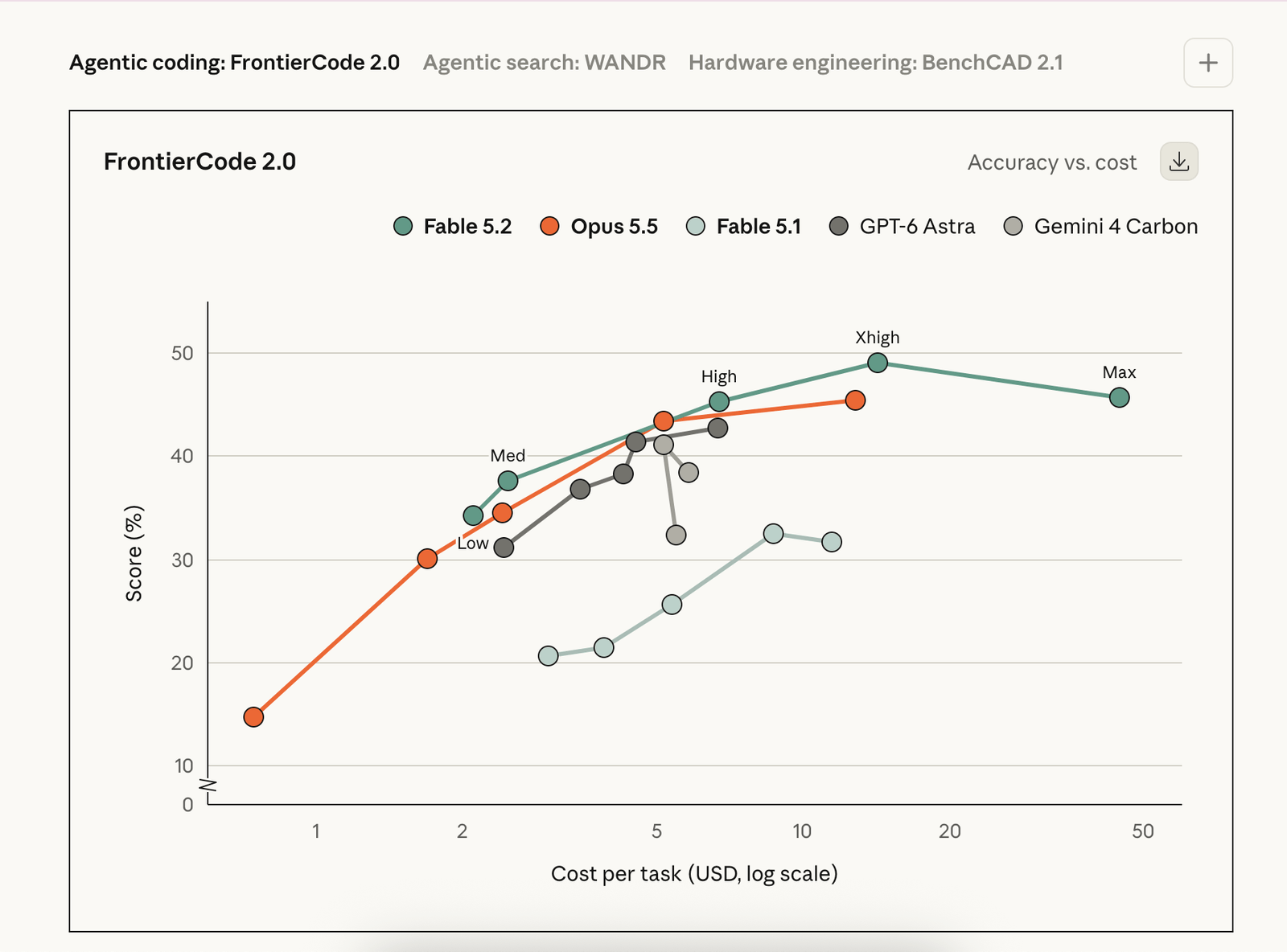
Anthropic's own testing illustrates this distinction. In its FrontierCode 2.0 evaluation, Fable 5.2 at High effort scored 45.3%, compared with 45.5% for Opus 5.5 at Max effort. Anthropic reported that Fable completed the task for roughly half the cost.
Fable is therefore better understood as an option for work that demands more reasoning and longer autonomous execution, rather than a universal replacement for Opus.
Anthropic also suggests using Fable in two additional roles:
- Advisor: Smaller models consult Fable when they encounter difficult problems.
- Orchestrator: Fable coordinates work and delegates simpler tasks to less expensive models.
Source: Anthropic - model recommendations and FrontierCode results
What does this mean for Shopify sellers?
The launch matters most to businesses and agencies that pay directly for AI model usage.
For Shopify agencies using Claude Code or the Claude API, lower token prices can reduce the cost of development, debugging, research and store maintenance.
But the impact depends on the tools being used.
Agencies and developers paying by API usage
They can benefit directly from the lower Fable pricing. However, Fable is still more expensive per token than Opus 5.5, so the right choice depends on the complexity and total cost of each task.
Shopify teams using AI development tools
Teams should check which underlying model their tools use and whether they can select Fable 5.2, Opus 5.5 or smaller models for different workloads.
Sellers paying monthly for AI apps
A lower API price does not automatically reduce subscription fees. The app provider must decide whether to pass those savings on to customers.
What to check before switching
- Identify the model currently powering your AI development workflow.
- Compare Fable 5.2 and Opus 5.5 on the same real store-development tasks.
- Measure total cost, completion time, retries and human corrections.
- Use Fast mode only when the value of speed justifies the higher price.
The bigger takeaway is that AI model selection is becoming an operational cost decision, not simply a question of choosing the newest or most powerful model.
Anthropic's latest launch makes advanced AI more affordable than before. But the best model for a Shopify business will still depend on what it needs to accomplish.
Sources
Official sources
- Anthropic - Fable 5.2 and Mythos 5.2 launch announcement
- Claude Fable 5.2 model documentation
- Claude Mythos 5.2 model documentation
- Anthropic API pricing
- Claude Platform release notes
Ask AI next
- Which Shopify app builders or AI coding tools already let merchants use Fable 5.2 or Opus 5.5 today?
- What tools can track total cost per completed task across Fable 5.2, Opus 5.5 and other AI models?
- How does Fable 5.2's adaptive thinking differ from Opus 5.5's reasoning approach in practice?
- What signals would show Anthropic plans further Claude price cuts or model consolidation soon?
- Which Claude model fits common Shopify tasks like product descriptions, theme fixes, or support bots?