All stories · Article
BFCM and peak-season margin leakage: revenue isn't profit
A 20% discount can push your break-even ROAS from 2.3x to approximately 3.4x. That means an ad campaign hitting October's target could lose money during Black Friday, even if reported revenue looks healthy.
Share: WhatsApp · Telegram · X · Facebook · LinkedIn · Email

And the discount itself isn't the only problem. VIP codes can reach customers who would have paid full price, while returns can erase revenue that advertising platforms have already attributed to a campaign.
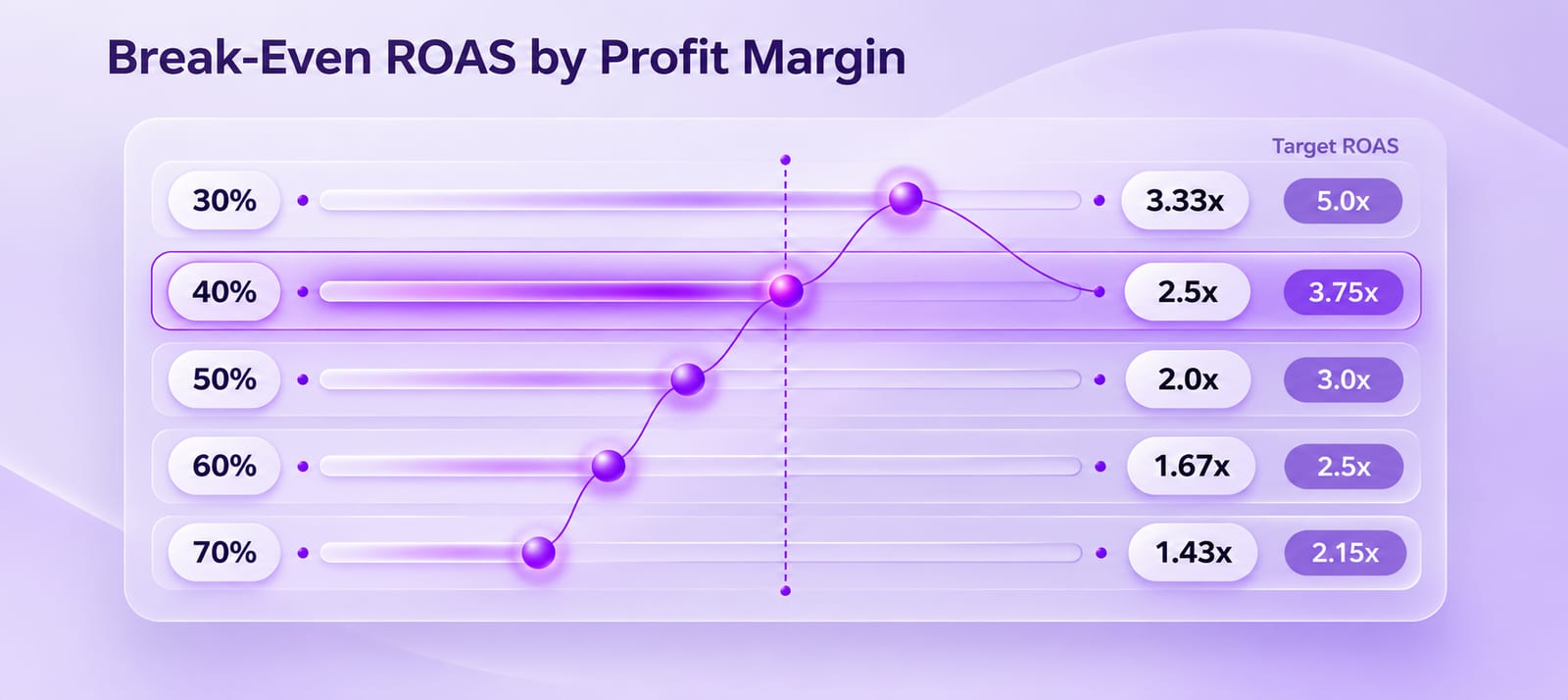
With Black Friday falling on November 27, Shopify sellers should recalculate their margins before finalizing their promotions and ad budgets.
Why a 20% discount changes your break-even ROAS
Break-even ROAS is determined by contribution margin, not revenue alone.
Consider a simplified example:
| Metric | Before discount | After 20% discount |
|---|---|---|
| Selling price | $100 | $80 |
| Variable costs | $56.50 | $56.50 |
| Contribution before ads | $43.50 | $23.50 |
| Contribution margin | 43.5% | 29.4% |
| Break-even ROAS | 2.3x | 3.4x |
The product still costs $56.50 to fulfill, but the store now collects $20 less.
Its contribution margin falls from 43.5% to 29.4%. Consequently, the break-even ROAS rises from approximately 2.3x to 3.4x.
This is an illustrative calculation based on the example discussed by Craig Graham, not a universal benchmark.
Who actually gets the discount you priced in?
Your margin calculation may assume that every discounted order represents a customer you acquired through a promotion.
But what happens when a VIP discount code reaches someone who was already prepared to pay full price?
That discount doesn't necessarily generate an incremental sale. It simply reduces the revenue from an order that might have happened anyway.
This is one form of discount leakage highlighted by Kaspian Fuad. Browser extensions can expose or distribute discount codes beyond their intended audience.
Shopify provides several controls to reduce this risk:
- Set eligibility to specific customer segments rather than all customers.
- Limit the code to one use per customer, using their email address or phone number.
- Use automatic discounts for public promotions, instead of distributing a reusable VIP code.
You can configure these settings under the discount's Eligibility and Maximum discount uses sections.
See Shopify's official discount configuration guide.
There is one important limitation: Shopify's customer-segment eligibility applies to existing customer profiles. New customers checking out for the first time may not yet belong to the segment.
Also, limiting eligibility does not stop a browser extension from sharing the code. It makes the code unusable for customers who aren't eligible.
Will a 3x ROAS on Black Friday still be 3x after returns?
There is another problem with evaluating campaign performance too early.
An advertising platform can attribute a purchase when the order is placed. But that doesn't mean the customer will keep the product.
If the order is later returned or refunded, the original purchase value no longer represents the revenue the business retains.
The scale of the problem is worth considering. According to the National Retail Federation's 2025 Retail Returns Landscape, retailers expected 17% of holiday sales to be returned in 2025.
That figure describes the broader US retail industry, not the expected return rate for every Shopify store.
For sellers, the practical issue is straightforward: a campaign can look profitable before returns are processed and much less profitable afterward.
Google Ads offers conversion adjustments that allow advertisers to retract returned purchases or restate conversion values after partial refunds.
Whatever your advertising setup, your internal reporting should connect orders to their eventual fulfillment, refund and return status.
Don't evaluate BFCM performance solely on the day the orders come in. Schedule a second review after your return window has matured.
When a deeper discount can still make sense
A larger discount isn't automatically a bad decision.
It can work when the promotion increases average order value, encourages customers to buy multiple products, or creates enough additional volume to offset the lower margin per item.
But there is a trade-off: customers acquired primarily through heavy promotions may not return at the same rate as full-price customers.
DTC Midas raises this concern, particularly for subscription-oriented brands.
The key is to distinguish between profitable growth and discounted revenue.
Some stores also have less exposure to these risks:
- Stores that don't rely heavily on paid acquisition.
- Stores with sufficiently high contribution margins to absorb discounts.
- Stores with low return rates and little discount-code exposure.
For example, a store with a 70% contribution margin before advertising has a break-even ROAS of approximately 1.43x. A 20% discount still changes that calculation, but the store starts with more room to absorb the reduction.
Before your BFCM emails go out
Three things are worth checking this week:
1. Recalculate your break-even ROAS.
Use the discounted selling price and actual variable costs for your three best-selling products. Include product costs, fulfillment, payment fees, shipping subsidies and expected return costs.
2. Secure your VIP discounts.
Restrict eligibility to the intended customer segment and limit usage to one redemption per customer. Use a separate automatic discount for public promotions.
3. Schedule a post-sale profitability review.
Reconcile ad-attributed orders with delivered orders, cancellations, refunds and returns. Review net revenue and contribution after the return window has matured.
The goal isn't to avoid discounts or stop spending on ads.
It's to make sure the revenue you're celebrating is revenue your business actually gets to keep.