All stories · Article
From ad to checkout: where the customer journey breaks
20,352 supplement ads are circulating as creative inspiration. But the winning message doesn't end at the click.
Share: WhatsApp · Telegram · X · Facebook · LinkedIn · Email

A supplement ad promises three products for $20. A customer clicks. The product page shows the price of one bottle, with no mention of the bundle.
The ad did its job. The landing page has yet to finish it.
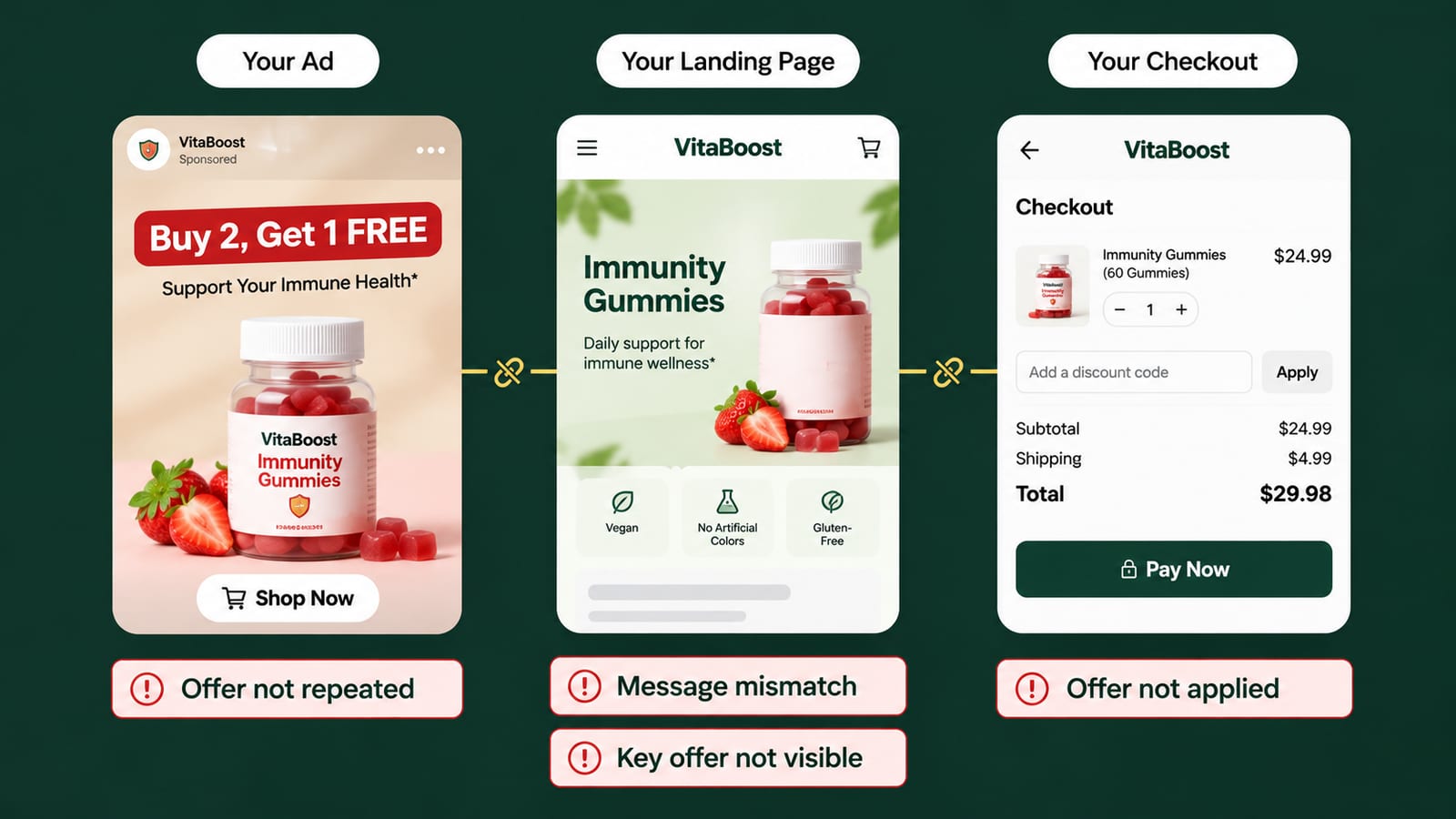
That disconnect is worth examining as marketers circulate thousands of static supplement ads and new Meta creative playbooks.
On November 5, 2026, Henry Crochemore shared a collection of 20,352 static supplement ads, filtered through the third-party tool GetHookd and labeled “winning.” Many rely on a simple selling point placed directly on the image: “3 for only $20” or “Buy 3, Get 3 Free.”
The following day, CRO practitioner Alex Momeni highlighted a similar issue in a hypothetical analysis of Salt & Stone: a dedicated landing page reinforced the promise in a deodorant ad, while other deodorant traffic still went to product pages or the homepage.
The takeaway for Shopify sellers is straightforward:
1. What is your static ad actually selling?
A static ad has very little time to earn attention. It often relies on one dominant message:
- An offer: Buy 3, Get 3 Free.
- A price: 3 for only $20.
- A product claim: A specific benefit or reason to buy.
The creative works by making the value immediately understandable. Customers don't need to read a long product description to understand the deal.
That is also why the message matters after the click.
The 20,352-ad collection is useful as a source of creative inspiration, but its label needs context. “Winning” is the classification used by the third-party tool, not independently verified proof of profitability. The $20 bundle is an example from the collection, not a ranking of the most successful offers.
There is another useful contrast. Lorenzo Pravata shared a Meta creative playbook used by a team managing more than $107 million in advertising spend. The playbook focuses on creative execution. It does not, by itself, solve what happens after a customer clicks.
2. Does your landing page need to repeat the ad's offer?
Yes - at least in meaning, and ideally in clear, recognizable language.
This is known in conversion optimization as message match: the landing page should reflect the message that brought the visitor there.
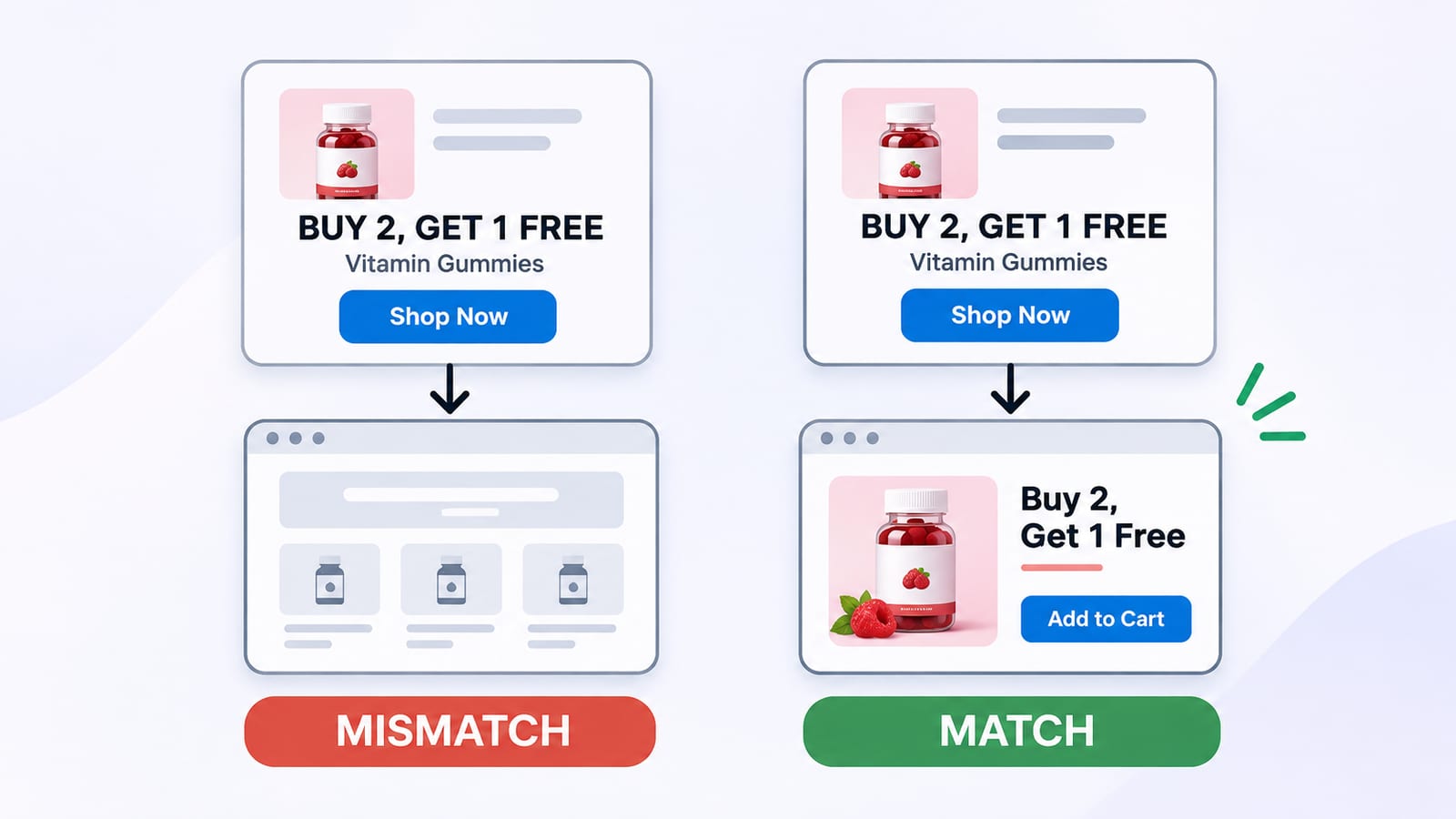
Unbounce defines message match as how closely landing-page copy matches the wording of the ad or link that brought someone to the page. The purpose is simple: reassure visitors that they have arrived at the right place.
Consider the difference:
| What the ad says | What the landing page says |
|---|---|
| 3 bottles for $20 | One bottle: $12 |
| Buy 3, Get 3 Free | Standard product pricing |
| Free shipping today | Shipping fee appears at checkout |
The problem isn't necessarily that the product page is poorly designed.
The problem is that the customer cannot immediately find the reason they clicked.
The gap can create three types of friction:
- Offer confusion: Is the advertised bundle actually available?
- Price uncertainty: Does the displayed price include the promotion?
- Trust loss: Was the deal in the ad real, or was it just a way to attract a click?
This is consistent with Baymard Institute's product-page research. Its usability research found that unclear pricing and discounts can create uncertainty and lead shoppers to abandon a product page. Price and promotional details should be prominent and easy to understand.
For a Shopify store, the first screen should make three things clear:
3. How do you know the problem is the page, not the ad?
A high click-through rate (CTR) with weak purchases is a reason to investigate the post-click experience. It is not proof that the landing page is the only problem.
In a November 5 post, ecomdiddy argued that when an ad attracts clicks but fails to generate purchases, sellers should examine the landing page rather than immediately replacing the creative.
That is a useful diagnostic starting point.
Read the funnel in stages:
| Signal | What to investigate |
|---|---|
| Low CTR | Creative, hook, audience and offer relevance |
| High CTR, low add-to-cart | Message match, product information, price and landing-page experience |
| High add-to-cart, low purchase | Shipping costs, payment options, checkout friction and unexpected fees |
| Purchases but weak profitability | Discounts, acquisition costs, margins and average order value |
Don't change the creative simply because purchases are low. First identify where customers are dropping off.
An ad can attract the right attention while the landing page fails to make the offer understandable. But a strong CTR can also come from an attractive yet misleading or poorly qualified hook. The numbers need to be read together.
4. A 10-minute check for your three biggest ads
You don't need to rebuild your storefront to start investigating.
Take the three ads currently spending the most money and open each destination on a mobile phone.
For each ad, follow this checklist:
A. Copy the exact promise
Write down the main message displayed in the creative.
- Is it a price?
- A bundle?
- A discount?
- Free shipping?
- A product benefit or health-related claim?
B. Open the destination page
Look only at what a customer sees before scrolling.
Can they immediately find:
- The same product or product variant?
- The advertised offer or promotion?
- The actual price and applicable discount?
- The main benefit or claim communicated by the ad?
- A clear next step to purchase?
C. Follow the offer through checkout
A promotion isn't properly communicated if it disappears after the product page.
Check whether:
- The bundle price is applied correctly.
- Free shipping is actually available under the advertised conditions.
- Discount codes work.
- Additional fees appear unexpectedly.
- The final checkout amount matches what the ad led customers to expect.
D. Have the ads and web teams review the same three examples
Ask three questions:
- What exactly did the ad promise?
- Where can customers see that promise on the landing page?
- Does the same offer remain valid through checkout?
This last step matters because advertising and website teams often work separately. Onieque Edwards has highlighted the risk of different teams writing ads and product pages at different times. When no one reviews the complete customer journey, inconsistencies can remain unnoticed.
5. One product page for every ad, or one page per angle?
There is no universal rule that every ad needs its own landing page.
The better question is whether each ad communicates a sufficiently different buying reason to justify a different page experience.
Consider two ads for the same supplement:
- Ad A: Buy 3, Get 3 Free.
- Ad B: Focuses on a particular ingredient and its supported product benefits.
Both advertise the same product, but they address different customer motivations.
Sending both to the same generic product page may work if the page clearly communicates both messages. However, if the first screen cannot accommodate both offers and buying angles without becoming confusing, separate landing-page variants may be worth testing.
The Salt & Stone example from Alex Momeni illustrates this possibility. In his hypothetical CRO analysis, a dedicated page reinforced the deodorant ad's message, while other traffic continued to land on product pages or the homepage.
This is an observation and a proposed test, not a verified conversion improvement.
A practical approach:
- One product, one offer, one buying angle: Start with the existing product page and fix its first screen.
- Multiple offers or distinct buying angles: Test dedicated landing-page variants.
- Uncertain which performs better: Split traffic and compare results.
Measure more than CTR. Track add-to-cart rate, checkout initiation, purchase conversion rate, revenue per visitor and contribution margin.
The goal isn't to create more pages. It is to give each visitor a relevant, consistent path from ad to purchase.
Frequently asked questions
Do I need to copy the exact wording from my ad?
Not necessarily. The customer needs to recognize the same offer, price, product and buying proposition. Exact wording is useful when the offer is specific, but clarity and consistency matter more than copying every sentence.
Does Meta require my landing page to repeat the offer in my ad?
The Meta Advertising Standards explain that ad review can consider the destination experience. However, the available official policy does not establish a blanket requirement that every offer must be repeated verbatim on the landing page. Message match is a CRO recommendation, not a confirmed Meta rule.
What if my supplement ad includes a health claim?
Message match does not make an unsupported claim acceptable.
The FTC's Health Products Compliance Guidance states that health-related advertising claims must be truthful, not misleading and supported by adequate scientific evidence. This applies to express and implied claims across advertising channels.
Do not simply repeat a questionable health claim on the product page. Verify the evidence and ensure the claim is appropriate before using it.
The takeaway
The 20,352-ad collection offers sellers thousands of ways to communicate a product offer. But creative inspiration is only half the job.
A customer who clicks “3 for $20” should not have to search a product page to discover whether the deal exists.
Start with your three highest-spending ads. Put each creative beside its mobile landing page. Check whether the offer, price and core product message are visible before the customer scrolls.
Before creating another ad, make sure the page is ready to receive the click.