All stories · Article
Listicle-style advertorials remain the preferred way to pre-sell cold traffic before the product page
Sending cold traffic straight to a product page asks shoppers to make a purchase decision before they have a compelling reason to buy.
Share: WhatsApp · Telegram · X · Facebook · LinkedIn · Email

That is why more ecommerce brands are putting content-led landing pages between their ads and product pages. Among these formats, listicle-style advertorials have become a popular way to introduce a product, build buying intent, and address objections before presenting the offer.
Koriderm offers a striking example. According to an analysis shared by ecommerce marketer Arijan Janes on November 2, 2026, 80% of the brand's 2,316 Meta ads directed traffic to listicle pages, with 72% pointing to a single listicle.
Source: Arijan Janes - Koriderm's Meta advertising analysis
The strategy reflects a shift in how brands approach paid acquisition: the ad captures attention, the advertorial builds the case for buying, and the product page closes the sale.
For Shopify sellers running cold traffic, understanding how these pages work - and when to use each format - can make a meaningful difference to the entire acquisition funnel.
Why brands put a listicle-style advertorial before the product page
A product page is designed to present and sell a product. But cold visitors often arrive with a different set of questions:
- Is this product relevant to my problem?
- Why should I consider this solution?
- What makes it different from alternatives?
- Can I trust the brand and its claims?
- Is it worth the price?
A conventional PDP has to answer these questions while also presenting product specifications, reviews, pricing, and purchase options. For products that require more explanation, that is a lot of persuasion to fit into one page.
A pre-sell page separates these jobs.
Instead of immediately presenting the product and its price, it first gives shoppers a reason to care. It introduces the problem, explains the potential solution, presents supporting evidence, and addresses common objections. By the time readers reach the product page, they have already received much of the information needed to evaluate the offer.
This is particularly relevant for products such as supplements, skincare, and pet care, where purchase decisions can involve education, trust, and several layers of consideration.
Why the listicle format works for this job
A listicle-style advertorial combines two useful content structures:
The advertorial provides the narrative. It introduces a problem, establishes context, explains why existing solutions may fall short, and positions the product as a relevant answer.
The listicle provides the structure. It breaks the argument into distinct reasons, benefits, mechanisms, or pieces of evidence.
For example, a skincare brand could build a page around:
7 Reasons Your Current Skincare Routine May Not Be Working
Each section can explain a specific concern, introduce a relevant product benefit, and support the claim with evidence or customer feedback.
Furry Freshness, a pet stain-remover brand, builds every reason on its listicle page this way.
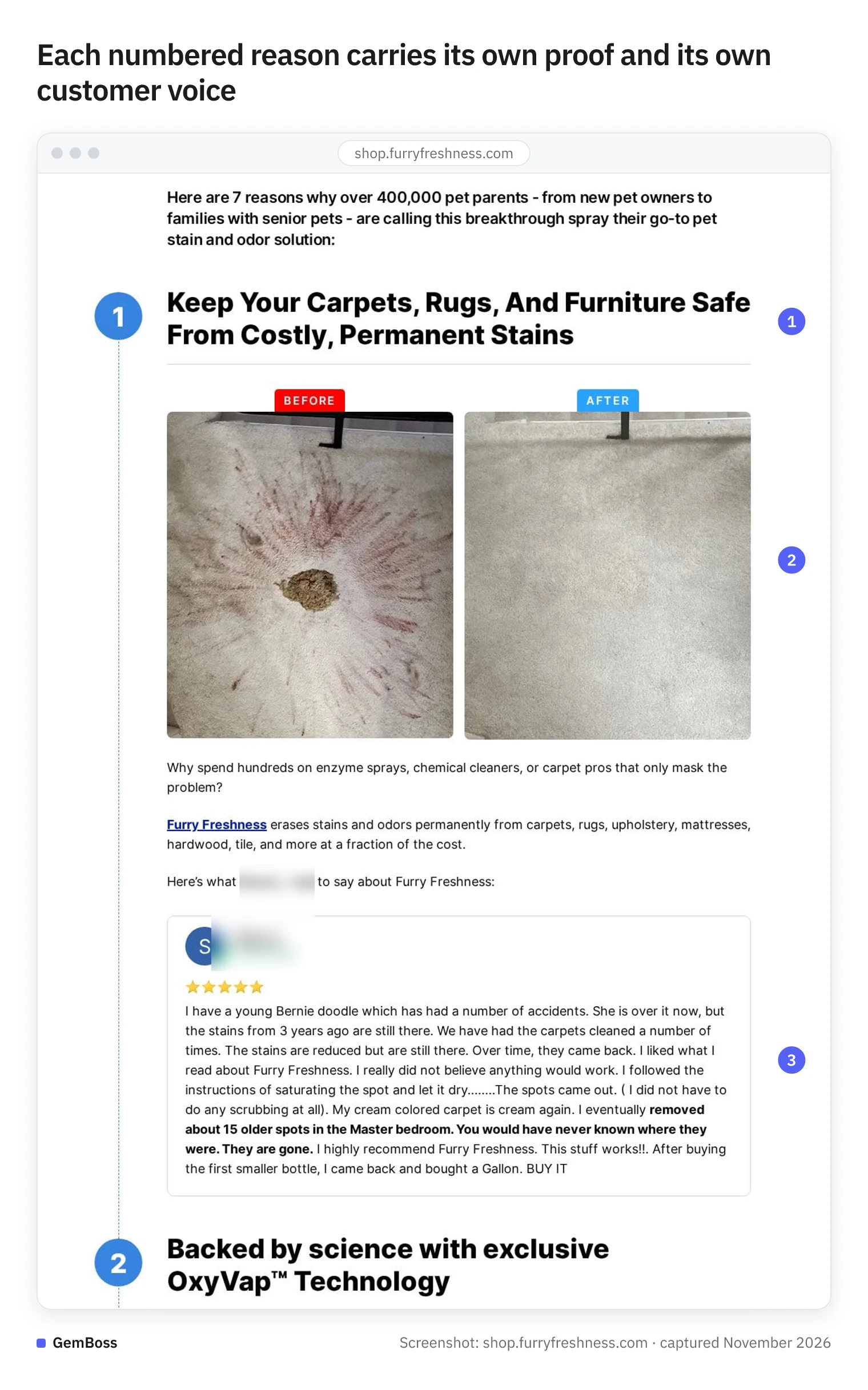
- The numbered heading states one concern in the reader's terms: keeping carpets and furniture safe from permanent stains.
- Before-and-after photos give that reason its own visual evidence.
- A customer review closes the reason before the page moves on to number two.
This structure is particularly suited to online reading. Visitors can scan the headings to understand the argument, then spend more time on the sections that address their concerns.
The result is a page that does more than describe a product. It builds a sequence of reasons for buying it.
What major brands are doing with these landing pages
Koriderm is not the only example of brands building dedicated funnels around cold traffic.
Alex Momeni shared an analysis of Javvy, a coffee brand running more than 1,500 ads. According to his post, its 15 leading landing pages were hosted on a separate funnel site rather than the brand's main storefront. These included an 11-reason listicle, quizzes, and seasonal listicles.
Source: Alex Momeni – Javvy's landing-page strategy
The distinction matters. The brand's main storefront and its paid acquisition funnel serve different purposes.
The storefront supports browsing, returning customers, and general product discovery. The dedicated funnel pages are built around specific advertising messages and the expectations of people arriving from those ads.
A similar pattern appears in Wuffes, a pet supplement brand. Lorenzo Pravata highlighted that the brand runs quiz funnels alongside listicle pages.
Source: Lorenzo Pravata – Wuffes' advertising funnels
Together, these examples reveal an important operating principle: brands are not simply sending every ad to the same product page. They are building different entry points for different customer motivations.
The listicle is one of the most visible formats in that system because it gives brands a repeatable way to explain a product through multiple buying reasons.
Listicle vs. editorial advertorial: what is the difference?
Although the terms are sometimes used interchangeably, they describe different approaches to presenting a sales argument.
| Format | Core structure | Main persuasion mechanism |
|---|---|---|
| Listicle | A numbered or clearly separated set of reasons, benefits, or findings | Makes the buying case easy to scan and evaluate |
| Editorial advertorial | An article-style narrative that introduces a problem and develops an argument | Builds context, understanding, and trust |
| Listicle-style advertorial | An editorial introduction followed by structured reasons, evidence, and product benefits | Combines storytelling with an easy-to-follow buying argument |
A listicle-style advertorial brings these elements together.
It can begin with a story or an observation that makes the reader recognize a problem, then use a series of numbered sections to explain why the product deserves consideration.
The format is useful because it gives the reader two ways to engage: follow the narrative from beginning to end or scan the headings and jump to the arguments that matter most.
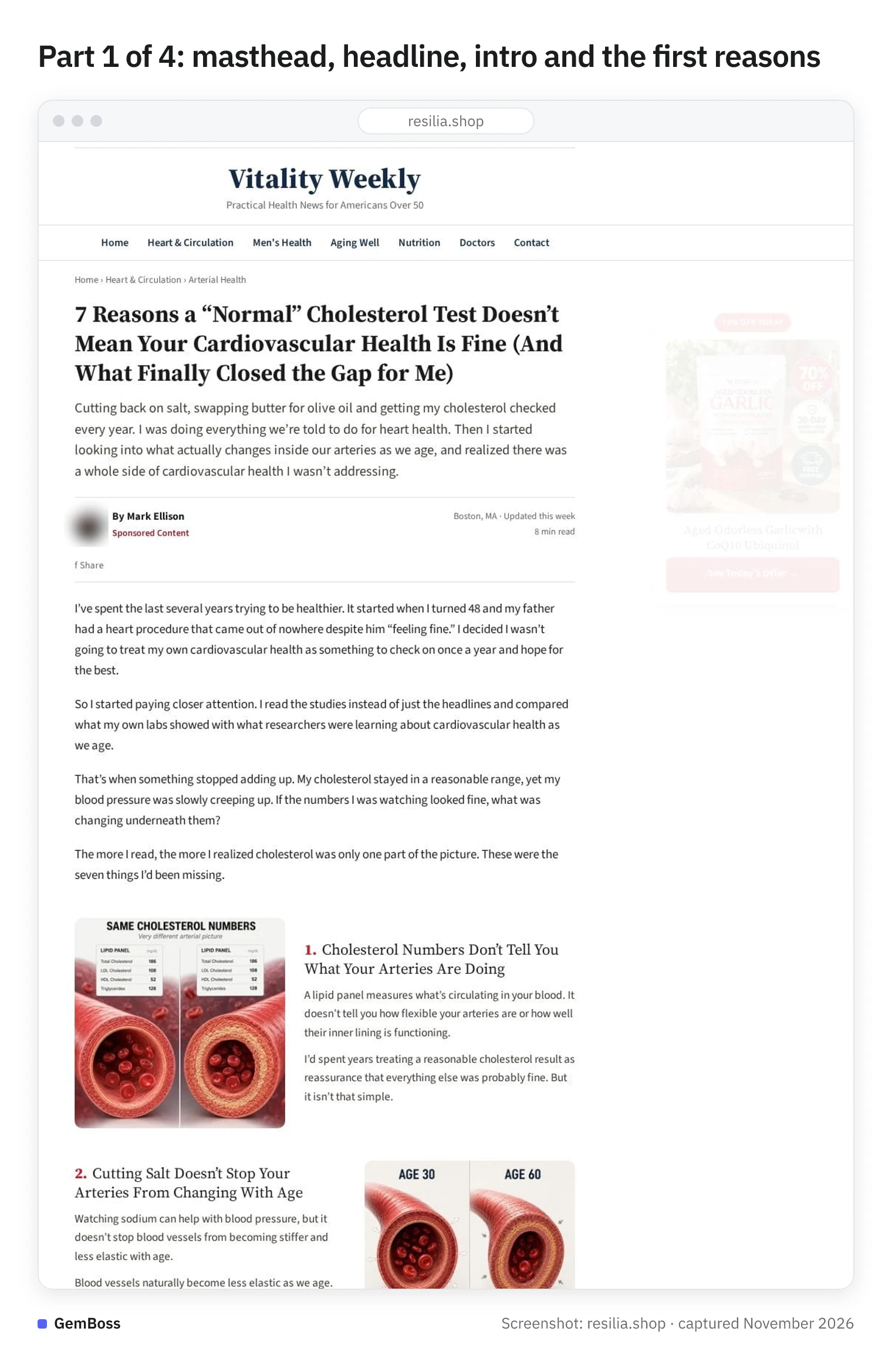
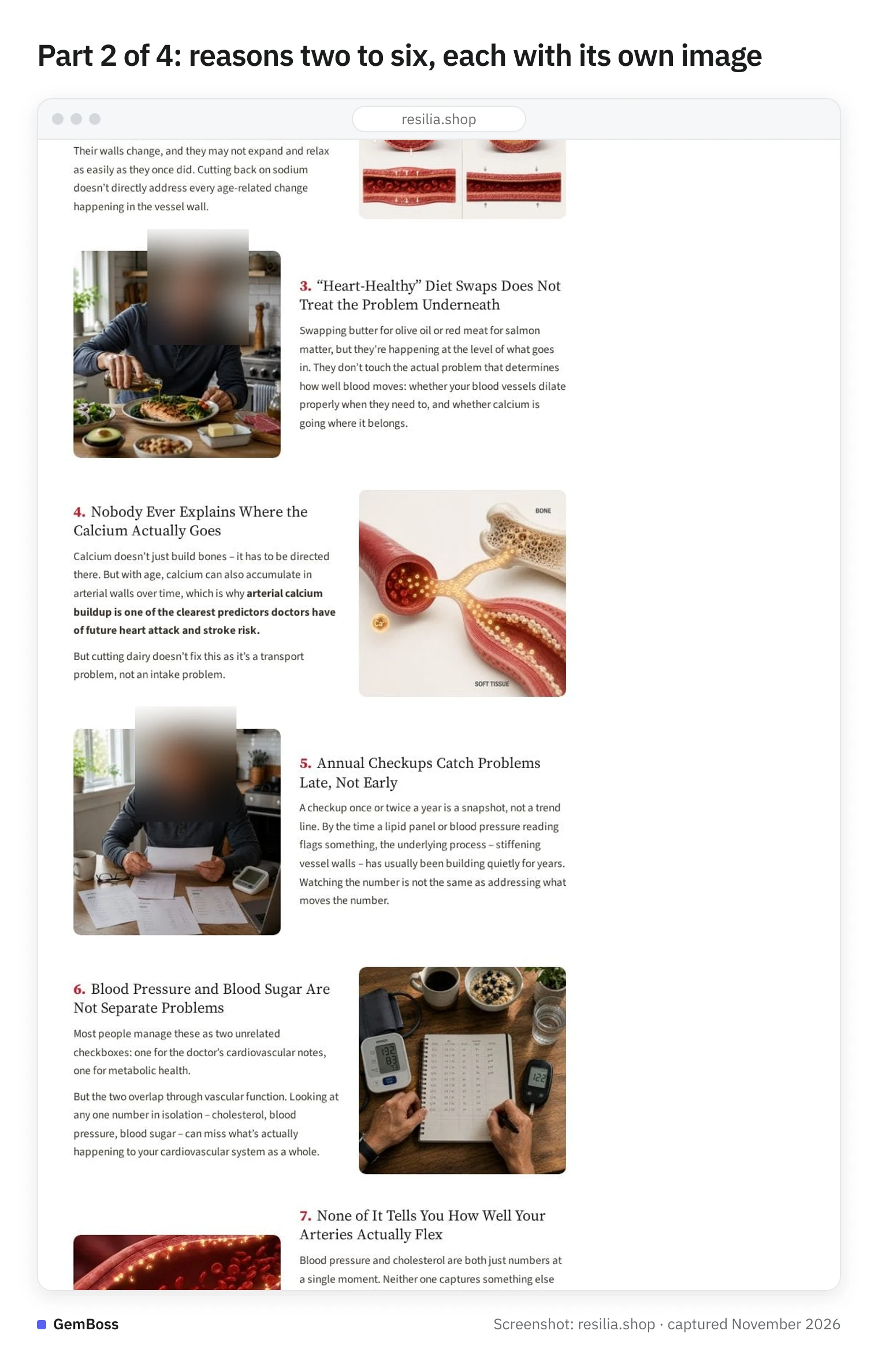
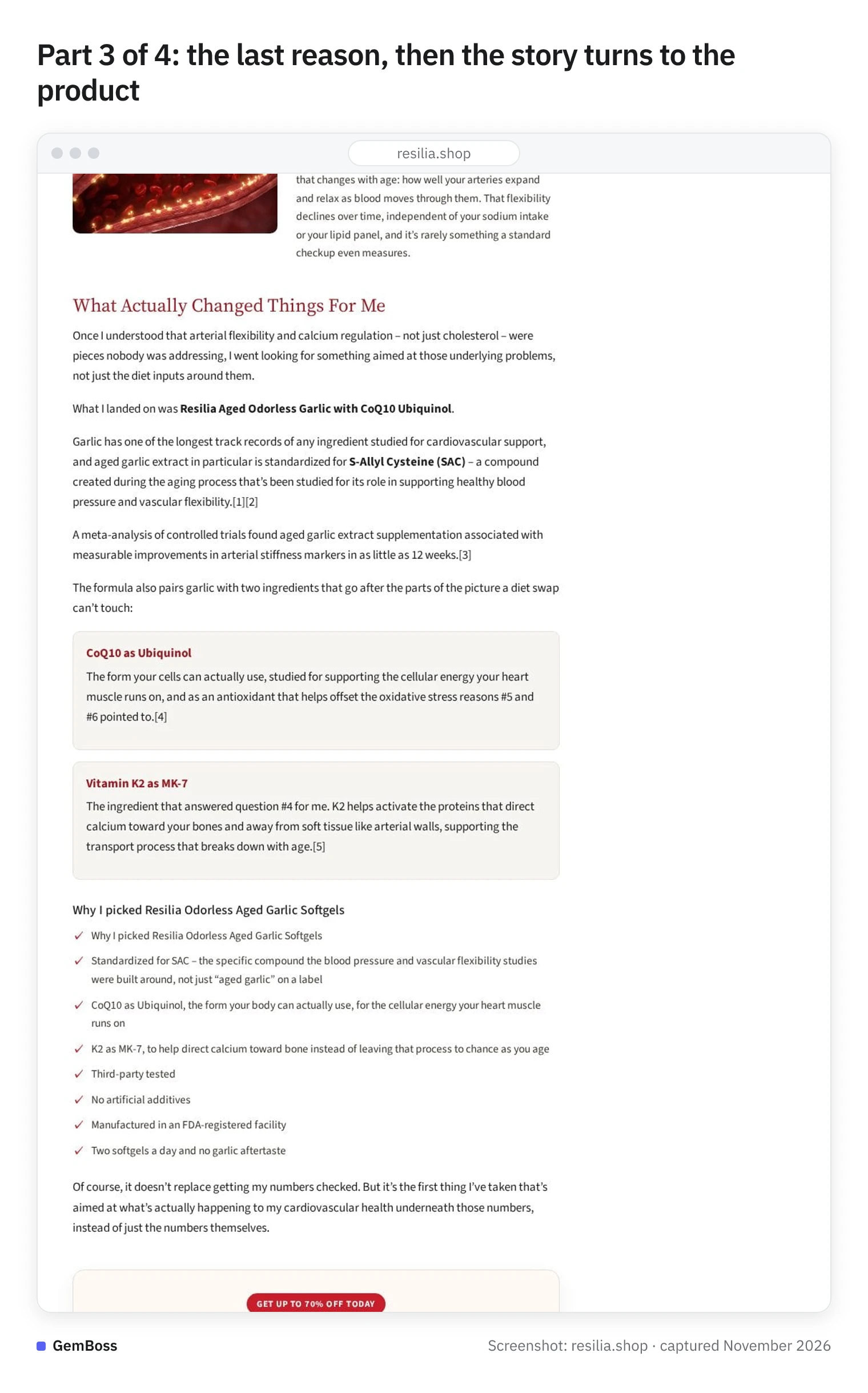
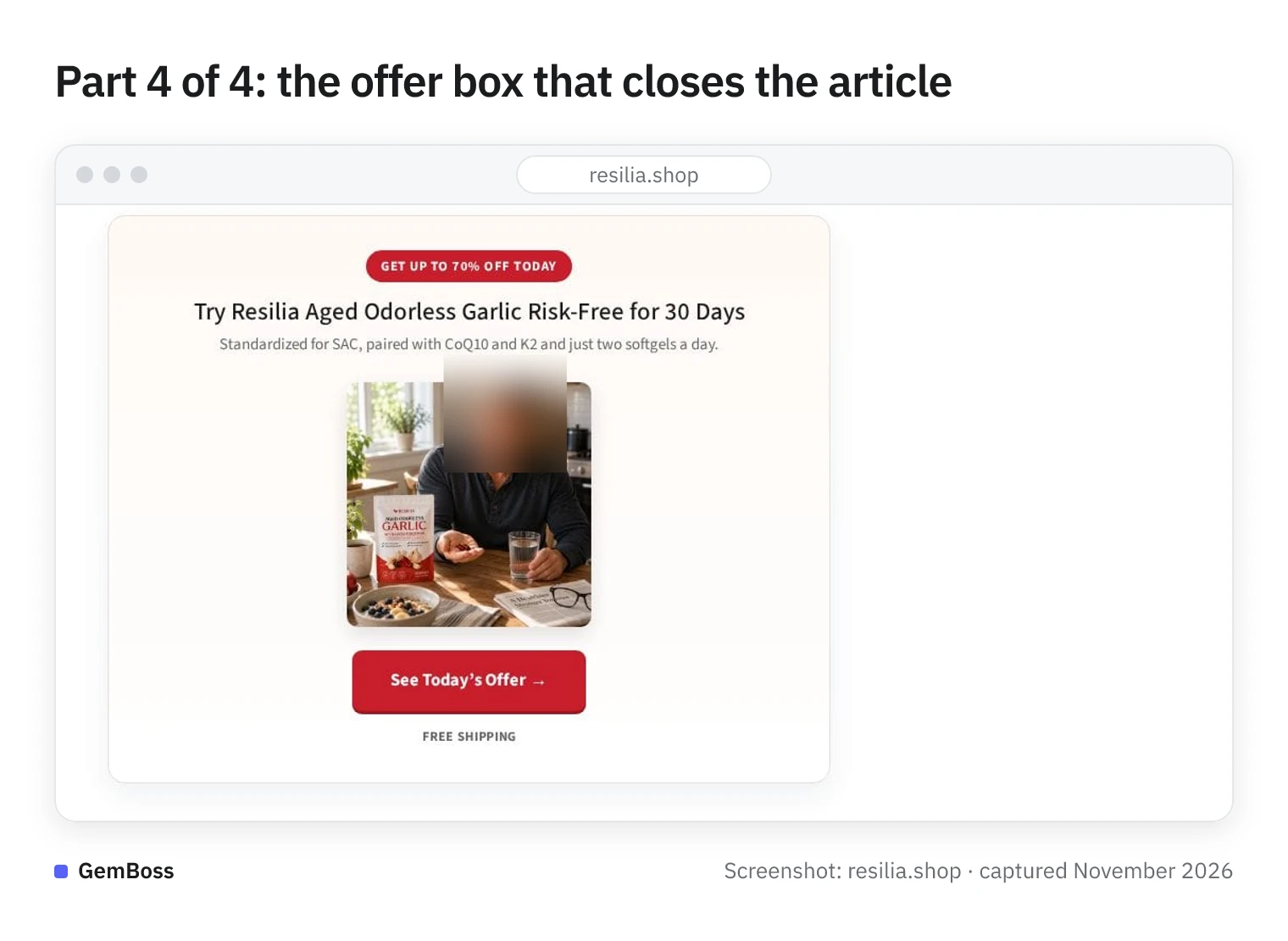
Resilia's cardiovascular-health page shows the whole combination. The outline below maps the page from top to bottom, and the four screenshots after it show the same page as it looks, from the masthead to the offer box (the reader comments at the very bottom are left out).
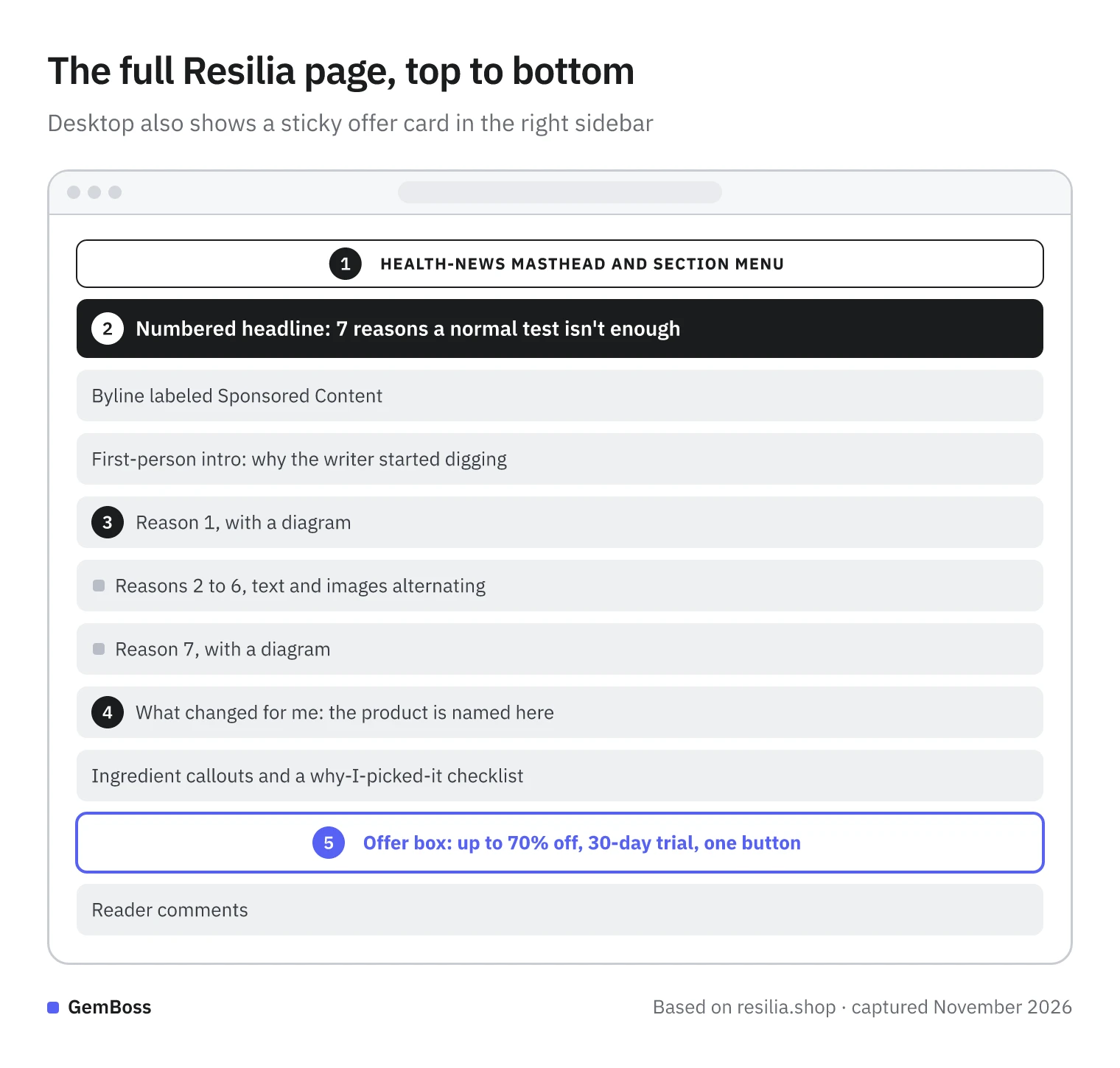
- A masthead and section menu make the page look like a health publication.
- The headline promises seven reasons, and the byline right under it is labeled "Sponsored Content".
- Seven numbered reasons fill most of the page, each with its own diagram or photo.
- Only after reason seven does the article name the product, backed by ingredient callouts and a checklist.
- The offer box comes last, just before the reader comments.
The $5,000 case: when an editorial advertorial wins
Ronak Shah shared a second-hand account of a supplement brand that tested several landing-page formats.
According to his post:
- An editorial-style advertorial achieved a reported $454 CAC.
- A polished branded landing page achieved a reported $682 CAC.
- A listicle consumed $5,000 in spend, with CAC exceeding $1,000, before being switched off.
Source: Ronak Shah - Reported supplement brand landing - page results
The case is based on a reported experience involving one brand, not an independently verified controlled experiment. Still, it offers a useful insight into how content structure affects persuasion.
A listicle is effective when customers need several clear reasons to consider a product. An editorial advertorial can be more effective when the central challenge is helping customers understand a problem or change an existing belief.
The distinction is not simply about page design. It is about the argument the customer needs to hear before buying.
For sellers, the practical question is whether the product needs a series of reasons or a more developed explanation to make the offer compelling.
When should a Shopify seller use a pre-sell page?
A dedicated pre-sell page is particularly useful when the advertising message introduces an idea that needs further explanation.
Consider these situations:
Supplements and wellness products
Customers may need to understand an ingredient, a mechanism, or the reason a particular product is relevant to their needs. A listicle can organize the benefits and evidence into clear sections.
Skincare
Customers often compare ingredients, routines, expected results, and alternatives. An advertorial can establish the problem and explain the product's role before introducing the offer.
Pet products
Pet owners may recognize a problem but need more information before choosing a solution. A listicle can explain the relevant reasons to consider a product, while an editorial narrative can provide additional context.
Products with unfamiliar features or higher consideration
When the product requires explanation, the pre-sell page can answer questions that would otherwise interrupt the purchase journey.
There are also situations where the existing PDP is already doing enough. Customers who know the brand, understand the product, and arrive with strong purchase intent may be ready to buy without reading another page.
The purpose of a pre-sell page is to handle the persuasion that the ad and PDP cannot complete on their own.
How to test a listicle-style advertorial before Black Friday
Black Friday 2026 falls on November 27. That gives sellers a clear deadline to evaluate their landing-page strategy before the holiday shopping period.
Source: Amazon - Black Friday 2026 date
Rather than building an entirely new funnel, start with one ad that is already generating purchases.
A practical two-page test
Step 1: Choose one winning ad.
Select an ad that consistently generates purchases from cold traffic. Its message should provide the foundation for the new landing page.
If the ad focuses on a particular product benefit, the pre-sell page should develop that same benefit rather than introduce an unrelated sales argument.
Step 2: Create two destinations.
- Version A: Your existing product detail page.
- Version B: A listicle-style advertorial built around the same advertising angle.
Keep the product, price, offer, and core message consistent. The main variable should be the destination page.
Step 3: Split traffic and measure the right metrics.
Divide eligible traffic between the two destinations under comparable campaign conditions.
Run the test for two full weeks if traffic volume allows. Monitor:
- Revenue per visitor (RPV).
- Customer acquisition cost (CAC).
- Purchase conversion rate.
- Average order value (AOV).
Revenue per visitor is particularly useful because it captures both the likelihood of a purchase and the value generated by each visitor.
Avoid declaring a winner based on a small number of purchases. Make sure both versions receive enough traffic and conversions to support a meaningful comparison.
Step 4: Keep the winning page for the holiday campaign.
Once the results are sufficiently reliable, use the stronger destination for your seasonal campaign.
Alex Momeni's pre-Black Friday advice is to retain listicles that are already converting and update the seasonal offer rather than rebuilding the page at the last minute.
Source: Alex Momeni - Pre-Black Friday landing-page advice
This is a practical recommendation from an ecommerce marketer, not a guarantee of performance. Its underlying logic is straightforward: use the time before the holiday rush to establish which page works, then focus on the offer and creative rather than making major structural changes during the busiest period.
The takeaway: the page should continue the conversation started by the ad
A cold-traffic funnel works best when every step has a clear job.
The ad introduces a problem, desire, or benefit. The listicle-style advertorial develops that message through a narrative and a structured set of buying reasons. The product page presents the offer and makes purchasing straightforward.
Koriderm's advertising activity shows how extensively a major brand can use listicle pages. Javvy and Wuffes demonstrate how dedicated funnel pages and multiple formats can support different customer entry points. The $5,000 case shows why the structure of the argument still matters.
For Shopify sellers, the opportunity is to stop treating the PDP as the only destination for paid traffic.
Build a pre-sell page around the message that made someone click. Give cold visitors enough context and evidence to understand the product. Then let the product page do what it does best: turn an informed buying decision into an order.
Sources · 8 · x.com, shop.furryfreshness.com, resilia.shop +2
- Source: Arijan Janes - Koriderm's Meta advertising analysis · x.com
- listicle page · shop.furryfreshness.com
- Source: Alex Momeni – Javvy's landing-page strategy · x.com
- Source: Lorenzo Pravata – Wuffes' advertising funnels · x.com
- cardiovascular-health page · resilia.shop
- Source: Ronak Shah - Reported supplement brand landing - page results · linkedin.com
- Source: Amazon - Black Friday 2026 date · aboutamazon.com
- Source: Alex Momeni - Pre-Black Friday landing-page advice · x.com